Navigating healthcare job postings in Walnut Creek, CA often feels like sorting through an alphabet soup of mandatory credentials. Job descriptions across Contra Costa County frequently list BLS, ACLS, or PALS as non-negotiable prerequisites, leaving applicants to figure out which card will actually clear them for hiring. Enrolling in an advanced course you do not need wastes time and money, while holding only basic credentials can halt your application for specialized clinical roles.
Your exact job target determines the certification level required by clinical managers and credentialing boards. Basic Life Support covers core resuscitation for nearly all patient-facing staff, Advanced Cardiovascular Life Support targets adult acute care, and Pediatric Advanced Life Support is required for specialized pediatric environments. This guide breaks down how East Bay employers evaluate these credentials, helping you select the precise course required for your career trajectory.
Key Takeaway: BLS CPR certification is the foundational requirement for virtually all healthcare workers and nursing students. ACLS and PALS build directly on BLS skills, adding advanced cardiac algorithms, pharmacology, and emergency airway management for adult or pediatric critical care roles.
Mapping Life Support Credentials to Healthcare Roles
Medical facilities do not assign certification requirements at random. Credentialing standards align directly with unit acuity, emergency response expectations, and patient demographics.
Basic Life Support (BLS)
A BLS CPR Certification Course is the baseline standard across clinical healthcare. It focuses on rapid assessment, high-quality chest compressions, bag-mask ventilation, and automated external defibrillator (AED) operation for adults, children, and infants.
BLS is designed for:
- Registered Nurses (RNs) and Licensed Vocational Nurses (LVNs) in general staff roles
- Nursing, dental, and allied health students entering clinical rotations
- Certified Nursing Assistants (CNAs) and Medical Assistants (MAs)
- Physical therapists, occupational therapists, and radiologic technologists
- Dentists and dental hygienists
Advanced Cardiovascular Life Support (ACLS)
ACLS expands beyond fundamental physical resuscitation to cover medical management during adult cardiovascular crises. Training includes ECG rhythm interpretation, manual defibrillation, cardioversion, cardiac pharmacology (such as epinephrine and amiodarone), and advanced airway placement.
ACLS is required for:
- Intensive Care Unit (ICU) and Cardiac Care Unit (CCU) nurses
- Emergency Department (ED) nurses and physicians
- Telemetry, step-down, and post-anesthesia care unit (PACU) staff
- Paramedics and critical care transport teams
- Hospitalists and cardiology fellows
Pediatric Advanced Life Support (PALS)
PALS addresses the distinct physiological needs of infants and children during severe illness or injury. Because pediatric cardiac arrest usually stems from respiratory failure rather than primary cardiac issues, PALS stresses early systematic assessment, advanced pediatric airway management, vascular access (including intraosseous placement), and weight-based resuscitation pharmacology.
PALS is required for:
- Pediatric ICU (PICU) and Neonatal ICU (NICU) clinical staff
- Pediatric emergency department nurses and physicians
- Outpatient pediatric clinic specialists and pediatric surgeons
- Emergency medical personnel responding to pediatric calls
Deciding Which Certification Your Job Search Requires
Selecting your course depends on your current career stage, your prospective employer’s unit guidelines, and whether you meet prerequisite standards.
1. Are You Entering a Healthcare Program or Applying for Entry-Level Roles?
If you are preparing for nursing school clinicals or applying for outpatient clinic positions, start with a BLS CPR Certification Course. BLS is the mandatory prerequisite for all advanced resuscitation tracks. Completing BLS first ensures your foundational CPR mechanics and team communication dynamics are solid.
2. Are You Targeting Inpatient Hospital Units?
Inpatient acute care facilities usually mandate credentials based on unit assignment. General medical-surgical floors often require only BLS. However, telemetry, progressive care, and emergency departments require ACLS prior to completing orientation. If your goal is a hospital floor handling continuous cardiac monitoring, obtaining your ACLS card alongside BLS makes your application far more competitive.
3. Will You Work with Pediatric Populations?
If your employment search focuses on pediatric facilities, family health centers, or emergency transport, PALS is necessary. Facilities managing both adult and pediatric emergencies—such as general emergency departments—frequently require clinical staff to hold BLS, ACLS, and PALS simultaneously.
Course Prerequisite and Content Comparison
Understanding the structural differences between these three American Heart Association (AHA) courses helps you prepare effectively for class day.
| Course Feature | Basic Life Support (BLS) | Advanced Cardiovascular Life Support (ACLS) | Pediatric Advanced Life Support (PALS) |
| Primary Focus | Fundamental CPR, AED, & Airway | Adult Cardiac Algorithms & ECGs | Pediatric Assessment & Resuscitation |
| Prerequisites | None | Active BLS Card & ECG Knowledge | Active BLS Card & Pediatric Dosing |
| Medical Devices | AED & Bag-Mask Barriers | Manual Defibrillators & Advanced Airways | Intraosseous Needles & Length-Based Tapes |
| Pharmacology | None | Adult Resuscitation Drugs | Weight-Based Pediatric Dosing |
| Testing | Hands-On Skills & Written Exam | Mega-Code Lead & Written Exam | Pediatric Case Lead & Written Exam |
Local Employment Trends for East Bay Healthcare Job-Seekers
Job-seekers across Contra Costa County navigate a highly competitive healthcare market. Major regional employers, including John Muir Health’s Walnut Creek Medical Center, Kaiser Permanente Walnut Creek Medical Center, outpatient surgical suites along Ygnacio Valley Road, and clinics throughout the East Bay, enforce strict credential verification guidelines.
Human resources departments and clinical nurse specialists require certification cards that align with official AHA guidelines. Presenting an unaccredited or non-compliant CPR card can delay your start date or invalidate your application entirely.
Healthcare workers living in Walnut Creek or commuting from neighboring East Bay communities—such as Lafayette, Moraga, Orinda, Martinez, Hercules, El Cerrito, and Oakley—frequently seek flexible training schedules. Blended learning options allow applicants to complete online cognitive modules on their own schedule before completing an efficient, hands-on skills verification locally.
Life Support Certification at Safety Training Seminars in Walnut Creek
Safety Training Seminars offers official American Heart Association BLS, ACLS, and PALS courses designed to help local job-seekers and working clinicians meet employer requirements without friction.
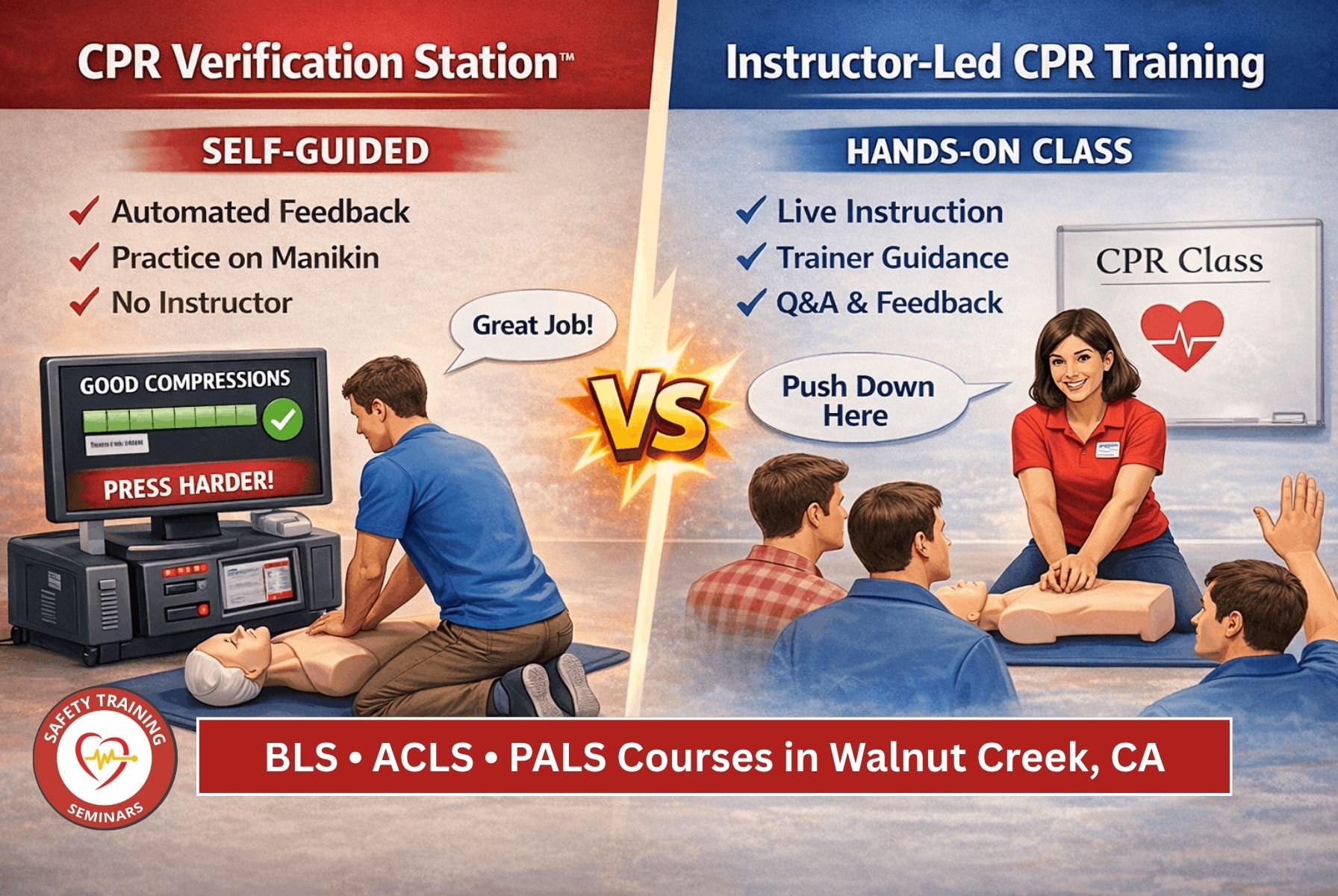
Classes follow the AHA blended learning format, pairing self-paced online coursework with an in-person skills evaluation at the physical office. Upon successful completion of your hands-on assessment, your official AHA eCard is issued on the same day.
The local training center is situated in downtown Walnut Creek:
Safety Training Seminars
2363 Boulevard Circle, Suite 18
Walnut Creek, CA 94595
This central downtown location allows job-seekers across the region to complete required certifications close to home. Clinicians residing in nearby towns can view specific course options through local schedules, including ACLS certification for Hercules healthcare workers, PALS training in Martinez, and BLS classes for Moraga nursing students.
Frequently Asked Questions
Can I take ACLS and BLS together if I am applying for a new job?
Yes. Many healthcare job-seekers need to complete both requirements before their start date. Blended learning allows you to complete the online portions for both BLS and ACLS prior to scheduling back-to-back in-person skills verifications at the training center.
Do Walnut Creek healthcare employers accept 100% online CPR cards?
No. Major hospitals, outpatient clinics, and surgery centers throughout Walnut Creek and Contra Costa County do not accept CPR certifications completed entirely online without a physical skills evaluation. Employers require cards issued through hands-on practice using accredited resuscitation manikins.
How long are AHA BLS, ACLS, and PALS cards valid?
All official AHA provider cards remain valid for two years from the end of the month in which the course was completed. To avoid lapses in employment eligibility, plan to complete your renewal course during the month prior to expiration.
What happens if I fail the written exam or hands-on skills evaluation?
If you struggle with a portion of the skills test or written exam, instructors provide targeted remediation on the spot. You are given the opportunity to review the material and re-test the specific algorithm or concept during your session.
Conclusion
Securing the right life support credential is a critical milestone for any healthcare job-seeker in Walnut Creek, CA. A BLS CPR Certification Course provides the essential foundation required across all patient care disciplines, while ACLS and PALS offer the advanced skills necessary for adult critical care and pediatric specialties. Verifying your target unit’s exact expectations before registering ensures your resume moves smoothly through employer credentialing.
Healthcare professionals across Walnut Creek, Lafayette, Moraga, Martinez, and surrounding East Bay communities can complete their certification requirements efficiently. Review current class availability, confirm your prerequisite needs, and reserve your hands-on skills session at the Safety Training Seminars Walnut Creek training center to keep your career moving forward.